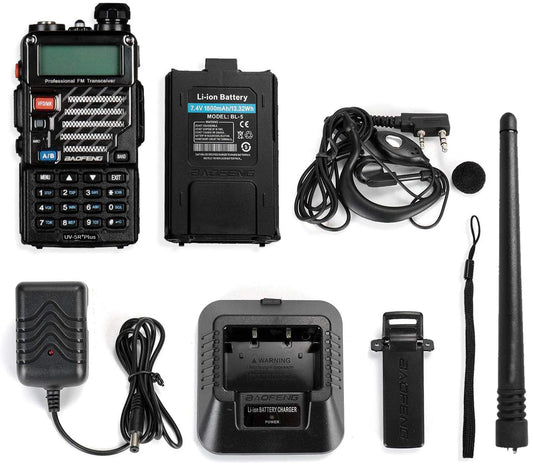
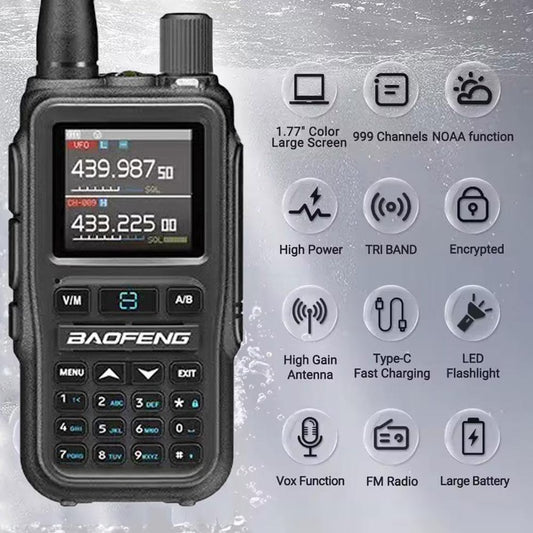
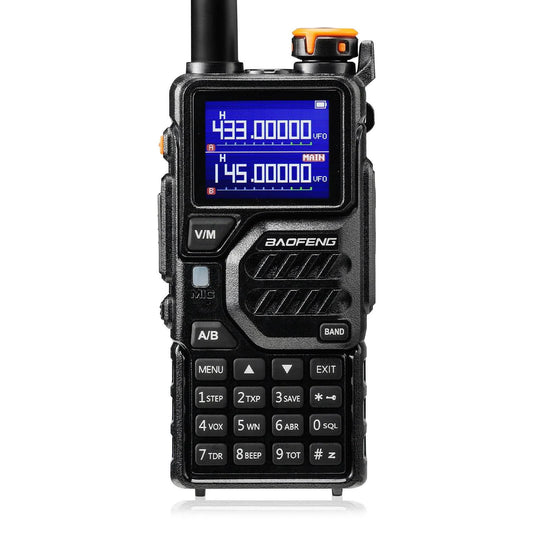
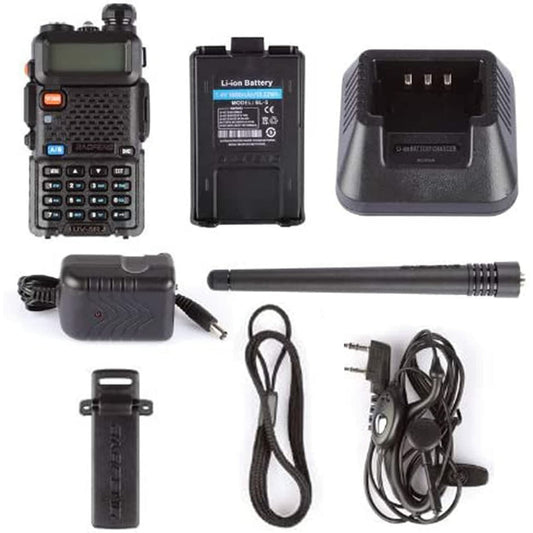
For most beginners, the best police scanner is the Baofeng UV-5R, pre-programmed to your ZIP code. It is the simplest proven way to start listening — no computer, no programming cable, no frequency research. If you want something pocket-sized, the UV-5R Mini is the same idea in a smaller body; if you want the widest coverage, including aircraft, the K5 Plus adds airband and more range. All three arrive loaded with the local channels that are actually receivable where you live.
Here is how to choose, and the one thing to check before you buy anything.
What makes a scanner good for a beginner
The hard part of scanners has never been listening — it is the setup. A blank scanner needs a cable, software like CHIRP, and hours of frequency research before it does anything useful, and that is where most first-timers give up. So the things that matter for a beginner are:
-
It arrives pre-programmed. Your local police, fire, EMS, and NOAA weather channels are already loaded to your ZIP code. Power on, press scan.
-
No license needed to listen. Listening to unencrypted public-safety traffic requires no FCC license and no technical background.
-
Simple controls. You want scan-and-listen, not a menu you need a manual to survive.
-
It matches your area. A scanner is only as good as what your county actually broadcasts — which is why you check coverage first, not after.
The three we'd point a beginner to
1. Baofeng UV-5R — the best choice for most beginners
The one to get if you are not sure. It is the most widely used handheld of its kind, dual-band, with a large display and simple scan controls. Pre-programmed to your ZIP code, it covers local police, fire, EMS, and NOAA weather out of the box. If you want to start listening today with the least fuss, this is it.
See the UV-5R →
2. Baofeng UV-5R Mini — same simplicity, pocket-sized
The same beginner-friendly approach in a smaller body, with USB-C charging and a color display. Choose this if portability matters — a go-bag, a glovebox, hiking, travel. Capability is close to the full-size UV-5R for everyday local listening.
See the UV-5R Mini →
3. Baofeng K5 Plus — for the beginner who wants room to grow
A step up in coverage: tri-band with airband and 1.25M reception, more memory channels, and a larger battery. Worth it if you want aircraft and air-attack traffic during fire season, or you already know you will want the widest coverage. It costs more than the UV-5R, and for local police, fire, and EMS the UV-5R covers the same ground — so only reach for the K5 Plus if the extra bands genuinely interest you.
See the K5 Plus →
Before you buy: check your county first
No scanner recommendation means anything until you know what your county broadcasts. Most US counties still run analog on at least some public-safety channels, and fire, EMS, and weather are analog almost everywhere — but a growing number of police departments have moved to encrypted or P25 digital systems that an analog scanner cannot decode. We would rather you know that before you order. (More on that trend in Do Police Scanners Still Work in 2026?)
Check what's receivable in your ZIP code →
The easy part: we program it for you
Whichever model fits, every scanner we ship is hand-programmed to your ZIP code before it leaves us. No software, no cable, no frequency lists to hunt down. It arrives ready to scan your area.
See all the pre-programmed scanners →
Best budget police scanners
You do not need to spend a lot to start listening. The Baofeng UV-5R and the pocket-sized UV-5R Mini are our most affordable pre-programmed scanners — both under $60 — and the UV-5R Plus adds extra memory for only a little more. Every model we sell costs well under $200 and arrives programmed to your ZIP code, so a good police scanner does not have to be an expensive one.
Frequently asked questions
What is the best police scanner for a beginner?
For most beginners, the Baofeng UV-5R pre-programmed to your ZIP code is the best choice — it is proven, simple to operate, and arrives loaded with your local channels so there is nothing to set up. The UV-5R Mini is the pocket-sized version, and the K5 Plus is the step-up option that adds airband and wider coverage.
Do I need any technical knowledge to use a police scanner?
No. A pre-programmed scanner arrives with your local police, fire, EMS, and weather channels already loaded. You turn it on and press scan — there is no software, cable, or frequency research required.
Do I need a license to use a police scanner?
No license is required to listen. Listening to unencrypted public-safety traffic is legal in almost every US state and needs no FCC license. Transmitting on those frequencies without a license is illegal, but simply scanning and listening is not.
What is the difference between the UV-5R, UV-5R Mini, and K5 Plus?
The UV-5R is the standard full-size handheld and the best all-round beginner pick. The UV-5R Mini is a smaller-bodied version with USB-C charging. The K5 Plus is tri-band with airband and 1.25M reception, more memory, and a bigger battery — best if you want the widest coverage rather than just local police, fire, and EMS.
Will a beginner scanner pick up my local police?
In most counties, yes — but it depends on your area. Many police departments still dispatch in analog, which any scanner receives, while some have moved to encrypted or digital systems that no analog scanner can decode. Fire, EMS, and weather are analog almost everywhere. Check your ZIP code in the free coverage checker before you order.
How much does a good beginner police scanner cost?
A pre-programmed analog handheld is the simplest and lowest-cost way to start listening. Dedicated digital trunk-tracking scanners cost several times more and are only necessary if your county runs an unencrypted P25 digital system — so check your area first, because if your county is analog you do not need the pricier hardware.
Are there good budget police scanners?
Yes. The Baofeng UV-5R at $59.50 and the pocket-sized UV-5R Mini at $59.95 are our best budget police scanners — affordable, pre-programmed to your ZIP code, and more than enough for most local police, fire, EMS, and weather listening. You only need a pricier digital scanner if your county actually broadcasts an unencrypted P25 digital system.
What is the best police scanner under $200?
Every police scanner we sell is under $200. The best value is the Baofeng UV-5R at $59.50; step up to the UV-5R Plus at $65.49 for more memory, or the K5 Plus at $116.50 for tri-band airband coverage. All arrive pre-programmed to your ZIP code.
What is the best radio scanner for beginners?
The best radio scanner for a beginner is a pre-programmed Baofeng handheld — the UV-5R for the full-size classic, or the UV-5R Mini if you want something pocket-sized. Both are simple to operate, arrive with your local channels already loaded, and need no cable or software to get started.
More places we cover